High Point Plaza, 4415 West Harrison Street, Suite 213, Hillside, IL 60162
High Point Plaza, 4415 West Harrison Street, Suite 213
Hillside, IL 60162
CALL TODAY FOR A FREE CONSULTATION
708-449-7404
Can a Prenuptial Agreement Address the Subject of Alimony in an Illinois Divorce?
 A prenuptial agreement, also known as a "prenup" or "premarital agreement," is a legal contract that many couples enter into before getting married. This agreement outlines how certain issues will be handled in case they get divorced. Prenups are particularly used to handle asset and debt division.
Premarital agreements can also address other important financial issues, such as alimony (called "spousal maintenance" in Illinois). If you and your fiancé are getting married in 2026 and considering a prenuptial agreement, and want to know more, a skilled Hillside family law attorney can help.
How Does Alimony Work in an Illinois Divorce?
Before we delve into how alimony can be handled in a prenuptial agreement, it’s important to first understand exactly how alimony works in an Illinois divorce, and when it can be awarded, under 750 ILCS 5/504.
Illinois characterizes marriage as a contract between two people that is largely financial. When people end their marriage, their financial situation usually changes dramatically. If one spouse earned much less than the other spouse, or gave up career opportunities to care for a household and children, alimony may be awarded. The purpose of alimony, therefore, is to help the receiving party maintain their standard of living while they transition into single life.
Alimony is less common than it used to be, thanks to the fact that in current times both spouses usually work, and stay-at-home parents are less common. In addition, spouses are encouraged to work out an alimony agreement between themselves whenever possible. A judge may order spouses to go to mediation meetings to try to figure out spousal support payments.
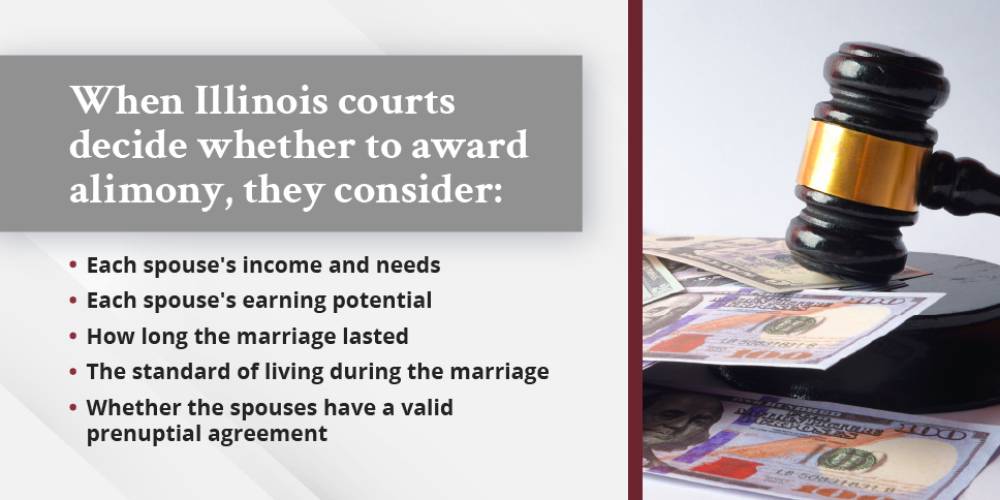
If spouses can’t negotiate a divorce settlement on their own, the court will consider several factors when determining whether to award spousal maintenance, how much should be awarded, and how long it should be paid. These factors include:
-
The income and property of each party;
-
The financial needs of each party;
-
The earning capacity of each party;
-
The duration of the marriage;
-
The standard of living established during the marriage; and,
-
Any valid agreements between the parties (such as a prenuptial agreement).
Prenuptial Agreements and Alimony
A prenuptial agreement can address how a couple will manage alimony if they get divorced. In a prenup, you and your spouse may want to outline the circumstances in which alimony will or will not be paid. You can also agree on how much support will be paid, and for how long, as well as when it can end.
Can a Prenup Waive Alimony Altogether?
Illinois law does allow prenuptial agreements to completely waive or set the terms of spousal maintenance. However, if not getting any alimony would leave a spouse unable to support themselves, a judge can refuse to enforce all or part of the prenup. A good example of when this might happen is a situation in which a spouse would be left after a divorce relying on food stamps or other public support without alimony.
Anticipating Future Financial Complications
When thinking about how to manage the subject of alimony in your prenup, you need to anticipate the post-divorce financial circumstances of both you and your spouse. Is there a chance that one of you will pull back from the workforce to take care of children? What happens if one of you loses a job or experiences a serious illness? What if you have a child with special needs who requires extensive care?
These factors may seem unlikely, but they often contribute to an evaluation of a prenup’s fairness at the time of divorce. A court will only enforce a prenup if the terms are fair and reasonable based on each party's income, assets, and earning capacity at the time of divorce.
The most airtight prenups include language addressing what will happen if there are significant changes in either party's financial situation during the marriage. This can help a couple make sure they are both financially secure after a divorce, as well as avoiding serious disputes in the future.
What Could Make a Prenup Unenforceable?
In order for alimony provisions within a prenuptial agreement to be enforceable, certain requirements must be met:
-
The agreement must be voluntary, and entered into by both parties with full disclosure of their finances to each other;
-
Both parties should have an opportunity to consult with their own attorneys before signing the agreement; and,
-
The terms should not be unconscionable or grossly unfair. This means that it can’t be possible for the terms to possibly leave one spouse destitute while the other spouse continues living as they did during the marriage.
If these requirements are met, courts will generally uphold alimony provisions in valid prenuptial agreements.
However, it is important to remember that judges still have discretion when determining spousal maintenance awards. A judge may deviate from what was agreed upon if they believe doing that is necessary.
Can’t We Just Negotiate Alimony when We Get Divorced?
You absolutely can negotiate alimony when you get divorced. In fact, most divorcing couples do. As part of the divorce process, you and your spouse can work out a settlement agreement that covers alimony payments. This agreement will become part of your final divorce decree or judgment. You may decide together how much will be paid, for how long, and under what conditions.
However, the benefit of addressing alimony in a prenuptial agreement is that you are both looking out for each other’s interests when you are feeling love and respect. It is much easier to negotiate a fair asset division, including alimony, when you aren’t angry at each other during the divorce process.
This does not in any way mean that creating a prenuptial agreement makes you more likely to get divorced. In fact, in many ways, negotiating a prenup may help prevent divorce by helping you have important conversations about finances and your values.
Nevertheless, the fact is that many marriages do end in divorce. If yours should, you can save yourself time, money and ill will towards your spouse by negotiating a fair asset division before your marriage. For many couples, this includes provisions about alimony.
Contact Our Hillside Divorce and Alimony Attorney
If you are considering a prenuptial agreement, and you have questions about addressing alimony, you should meet with a highly-experienced family law attorney. At the Law Office of Vincent C. Machroli, P.C., our Oak Park prenuptial agreement lawyer fully understands Illinois laws about divorce, spousal support and prenuptial agreements.
We can work with you to draft a prenup that protects your interests now and in the future. Contact us at 708-449-7404 to schedule a free consultation.
Contact Our Firm
 The use of the Internet or this form for communication with the firm or any individual member of the firm does not establish an attorney-client relationship. Confidential or time-sensitive information should not be sent through this form.
I have read and understand the Disclaimer and Privacy Policy.










PHONE: 708-449-7404 | FAX: 708-449-7406